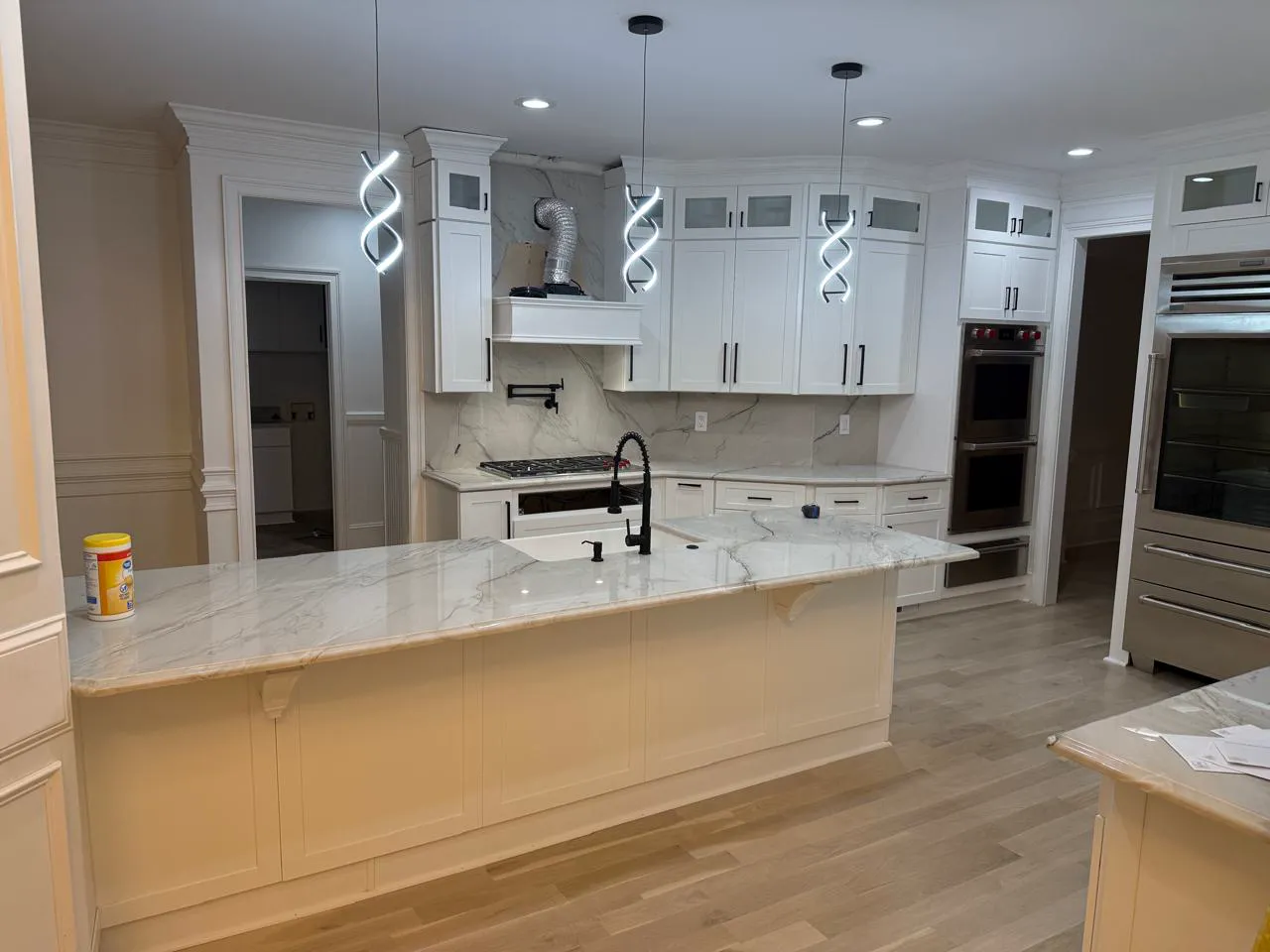
Quartzite vs. Quartz Countertops: What's the Difference?
Published •9 min read
The names are almost identical, but quartzite and quartz are very different materials. Quartzite is a natural stone, quarried from the earth like granite and marble. Quartz countertops are engineered: crushed quartz bound together with resin and pigments in a factory.
In short: quartzite gives you the look of natural stone, often with marble-like veining, along with excellent hardness, heat tolerance and suitability outdoors. In return, it usually needs sealing and tends to cost a little more. Quartz gives you consistent color, no sealing and simple care, but its resin makes it more sensitive to heat and strong sunlight. Below is a side-by-side comparison, what each costs, and how to make sure a stone sold as quartzite really is quartzite.
Quartzite vs. Quartz at a Glance
| Quartzite (natural) | Quartz (engineered) | |
|---|---|---|
| What it is | Natural metamorphic rock made almost entirely of the mineral quartz | Crushed quartz bound with resin and pigments, made into slabs |
| Look | Natural veining and movement; every slab is different | Consistent color and pattern from slab to slab |
| Hardness | Very hard; harder than glass and a knife blade | Hard, but the resin makes it softer than natural quartzite |
| Etching from lemon or vinegar | Real quartzite does not etch from everyday kitchen acids | Doesn't etch the way marble does |
| Sealing | Depends on the stone; more porous quartzites benefit from sealing | Not needed (Silestone's guide says not to apply sealants) |
| Heat | No resin to scorch; a trivet is still a good habit | Resin can scorch; use a trivet or hot pad |
| Outdoors and strong sun | Suitable outdoors | Most standard quartz is made for indoor use |
| Cost | Generally higher (see the cost section) | Generally a little lower (see the cost section) |
What Quartzite Is, and What Quartz Is
Quartzite starts as sand, often from an ancient beach or dune. Over millions of years, that sand becomes sandstone and is then buried deep enough that heat and pressure fuse the grains into a dense metamorphic rock. The Natural Stone Institute describes quartzite as made almost entirely of the mineral quartz. Other minerals give some quartzites their color, such as blue, green or gold tones.
Engineered quartz is manufactured. Quartz particles are mixed with resin, pigments and other ingredients, pressed into slab-shaped molds and cured. Manufacturers often cite a high quartz percentage, but the Natural Stone Institute points out that figure is measured by weight and is a maximum. The actual share varies by brand and color.
Durability, Heat and Everyday Use
Scratches and wear
Quartzite is one of the hardest natural stones used for countertops. The Natural Stone Institute notes that real quartzite is harder than both glass and a steel knife blade. Engineered quartz is also very durable for daily use, but the resin makes it softer than natural quartzite. On either surface, use a cutting board: on quartzite, mainly because the stone is hard enough to dull your knives.
Acids and etching
This is where quartzite differs from marble, even though the two can look alike. According to the Natural Stone Institute, real quartzite does not etch from everyday kitchen acids such as lemon juice or vinegar, while marble does. Very strong chemicals, such as some rust removers, can still affect stone, so use cleaners meant for stone.
Heat
Quartzite has no resin, so there is nothing to scorch. Quartz is different: Silestone's care guide warns that hot pans, pots and small appliances placed directly on the surface can cause scorching, dull areas and cracks, and recommends a trivet or hot pad. With quartzite, the Natural Stone Institute still recommends trivets and cooling racks as a simple preventive habit.
Outdoor kitchens and sunny spots
For outdoor kitchens, covered patios or counters in strong sun, quartzite is the stronger choice. The Natural Stone Institute notes quartzite isn't affected by weather or UV light, while the resin in engineered quartz can yellow in sunlight. Silestone's own guide says not to place its standard quartz outdoors or under UV light.
Care and Sealing
Quartz is the simpler surface to look after. It's non-porous, and Silestone's care guide calls for soap and warm water or a pH-balanced cleaner, avoiding bleach, oven cleaners and other strongly alkaline products.
Quartzite is cared for much like granite: wipe up spills promptly and clean with a gentle cleaner made for stone. Whether it needs sealing depends on the specific stone. The Natural Stone Institute explains that some quartzites, such as Taj Mahal, are tightly bonded, while others, such as White Macaubas, are more porous and benefit from sealing. It adds that modern sealers can last anywhere from one to ten years. A practical sign that sealing may be due is the stone darkening around the sink when it gets wet. Your fabricator can recommend the right sealer for your stone.
For a full care routine, see our guide on how to care for natural stone countertops.
Is It Really Quartzite? How to Check Before You Buy
The Natural Stone Institute warns that quartzite is commonly mislabeled. Some stones sold as quartzite, or as "soft quartzite", are actually marble or dolomitic marble, which scratch and etch much more easily. It specifically notes that Super White is most commonly a dolomitic marble. Price, country of origin and the name on the tag don't tell you which it is, so test a sample:
- 1Glass test: press a rough, pointed edge of a sample firmly across a glass tile. Real quartzite scratches glass easily, and you'll hear and feel it bite. Marble leaves little or no scratch, often just a powdery trail.
- 2Knife test: if there's no rough edge, try to scratch the surface with a knife tip. Real quartzite will be scratched lightly or not at all, while marble scratches easily.
- 3Etch test: leave a little lemon juice or vinegar on the stone for about 15 minutes, then wipe it off. Quartzite shows no change. A dull, lighter or darker spot means marble.
Do these tests on a sample or offcut, not a finished countertop, and test more than one area if the stone has mixed colors.
Cost: Quartzite vs. Quartz
Quartzite generally costs more than quartz, partly because it's quarried and partly because its hardness makes fabrication slower and harder on tooling. The figures below are national installed-cost estimates. They come from different publishers using different assumptions, so they show the general range rather than a direct comparison, and they are not Mega Solutions prices.
| Source (updated) | Material | Estimate | What it assumes |
|---|---|---|---|
| HomeAdvisor (June 2026) | Quartzite | $80-$220 per sq. ft. installed; about $3,950 average | 30 sq. ft. of countertop |
| Fixr (Aug. 2025) | Quartzite | $80-$210 per sq. ft. installed; about $4,200 average | 30 sq. ft. with a bullnose edge and undermount sink |
| Fixr (Jan. 2026) | Quartz | $2,600-$4,400; about $3,500 average | 35 sq. ft. of mid-grade quartz |
Fixr breaks quartzite down into about $50 to $120 per square foot for the slab and $30 to $90 for fabrication. Rare or highly figured slabs cost more. As with any stone, the edge profile, cutouts, finish and the size of your layout all move the final price, and a honed or leathered finish adds about $10 to $25 per square foot, according to HomeAdvisor. For a closer look at how stone is priced, see our granite countertop cost guide.
A Note on Silica Dust
The February 2026 OSHA and NIOSH hazard alert on silica in the countertop industry lists natural quartzite among the stones with the highest crystalline silica content (95% or more), while engineered stone ranges from under 0.2% to about 95% depending on the product. The alert concerns workers who cut, grind and polish stone, which releases silica dust. Everyday use of an installed countertop doesn't involve those tasks. If a counter ever needs cutting or drilling, have a professional do it.
Which Should You Choose?
Quartzite is likely the better fit if you:
- want natural stone with a marble-like look but much better resistance to etching and scratching
- are planning an outdoor kitchen or a counter in strong sun
- want a surface that handles hot cookware better than quartz
- don't mind periodic sealing, depending on the stone
Quartz is likely the better fit if you:
- want the simplest care, with no sealing
- want a consistent color or pattern across a large kitchen
- have a tighter budget
- are fine using trivets and keeping the counter indoors
Comparing other stones too? See quartz vs. granite and marble vs. quartz. You can also try quartzite and quartz with different cabinet finishes on our Colors page.
Frequently Asked Questions
Is quartzite the same as quartz?
No. Quartzite is a natural metamorphic stone made almost entirely of the mineral quartz. Quartz countertops are an engineered product made from crushed quartz, resin and pigments.
Is quartzite more expensive than quartz?
Usually. National guides put installed quartzite at roughly $80 to $220 per square foot, with averages around $3,950 to $4,200 for 30 square feet. Fixr puts a typical quartz project at about $3,500. The sources use different assumptions, so get a quote for your specific stone and layout.
Does quartzite need to be sealed?
It depends on the stone. Tightly bonded quartzites such as Taj Mahal are less porous, while more porous ones such as White Macaubas benefit from sealing. Your fabricator can recommend a sealer and schedule for your stone.
Can quartzite stain or etch?
Real quartzite does not etch from everyday kitchen acids like lemon juice or vinegar. More porous quartzites can absorb stains if they aren't sealed, so wipe spills promptly. If a stone sold as quartzite etches, it is likely marble.
How can I tell if my quartzite is real?
Test a sample. Real quartzite scratches glass, resists a knife tip, and shows no change after about 15 minutes under lemon juice or vinegar. Marble fails these tests.
Which is better for an outdoor kitchen?
Quartzite. It isn't affected by weather or UV light, while the resin in standard engineered quartz can discolor in sunlight, and manufacturers such as Silestone advise against using their standard quartz outdoors.
Planning Stone Countertops? Get a Quote from Mega Solutions
Choosing between quartzite and quartz is easier when you can compare real materials for your own kitchen.
Mega Solutions installs quartzite, quartz, granite and marble countertops, and also sells and installs cabinets. Whether you're replacing your countertops or planning a larger kitchen update, you can request a personalized quote based on your measurements, preferred materials and project details.
Before requesting your quote, it helps to have:
- Approximate countertop measurements
- Photos of your existing kitchen
- Preferred stone materials or colors
- Sink and cooktop details
- Whether the countertop will be indoors or outdoors
- Whether old countertops need to be removed
Sources
- Natural Stone Institute, "The Definitive Guide to Quartzite": usenaturalstone.org
- Natural Stone Institute, "Natural Quartzite and Engineered Quartz: What's the Difference?": usenaturalstone.org
- Natural Stone Institute, "Caring for Quartzite Countertops": usenaturalstone.org
- HomeAdvisor, "What Do Quartzite Countertops Cost?" (updated June 2026): homeadvisor.com
- Fixr, "Quartzite Countertops Price" (updated August 2025): fixr.com
- Fixr, "Quartz Countertop Installation Cost" (updated January 2026): fixr.com
- Cosentino, "Silestone Care & Maintenance" (U.S. care guide): cosentino.com
- OSHA and NIOSH, "Hazard Alert: Worker Exposure to Silica during Countertop Manufacturing, Finishing, and Installation" (February 2026): cdc.gov
Ready to start your kitchen project?
Get a free, no-obligation quote from Mega Solutions. We'll walk through your space and put together a plan that fits your budget.